
GMCC, our partner organization Sanctuary Supply Depot, and one of our Minnesota FoodShare March Campaign participants, Joyce Uptown Food Shelf, were all mentioned in this article titled “The Revolutionary Neighborliness of Minneapolis”, written by Joseph Mogul for The Progressive Magazine. Read the excerpts below:
Over a cup of coffee, Naomi Wilson, an organizer with the mutual aid collective Sanctuary Supply Depot, shows me her friendship bracelets that she made with unhoused neighbors. “Everything I do in my life is motivated by love for my neighbor,” she says. “To see the whole metro region mobilize around loving their neighbor . . . that gives me hope.” When Wilson and her husband moved to Phillips in 2022, their home was located on the same block as an encampment. “It was very easy to build relationships with unhoused people,” Wilson says.
In 2020, organizers with the sanctuary movement, a weeks-long project to shelter unhoused people in a South Minneapolis hotel, founded Sanctuary Supply Depot. “The goal from our inception was being an abolitionist movement dedicated to providing survival supplies for unhoused people,” says Wilson, who joined in 2022. “I think the city, in the aftermath of the murder of George Floyd, was able to build a really robust mutual aid infrastructure,” she says. “Now we are trying to carry on that legacy.”
Sanctuary Supply Depot has open hours during which unhoused people can pick up free tents and survival supplies, and they partner with other groups that distribute supplies in St. Paul, where there are still large encampments. Every Sunday, they organize pop-ups to hand out sandwiches and water in communities with large unhoused populations. But the presence of ICE has severely disrupted their operations. “It’s a perpetual state of unknowing and worry, ” Wilson says. “Unhoused people are particularly vulnerable to ICE, because it’s not the same as if you have a family at home wondering where you are. There’s fear that unhoused people are just being disappeared.” She has lost contact with multiple neighbors who she worries were taken by ICE, and encourages people to shelter at MIWRC when possible.
The article also features Christin Crabtree, who GMCC has engaged with through her work organizing for Camp Nenookaasi. The encampment has moved locations several times over the years, due to constant sweeps and displacement. Nenookaasi was always in close proximity to GMCC’s facility, so many unhoused relatives became regulars at our Friday Drop-in Services program.

Christin Crabtree sorts through mutual aid donations for unhoused people at the Minnesota Indian Women’s Resource Center in Minneapolis, on January 31, 2026. Photo credit: Joseph Mogul
In 2023, Greater Minneapolis Council of Churches (GMCC), an interfaith, social services nonprofit located in the heart of Minneapolis’s immigrant community on Lake Street, invited Sanctuary Supply Depot to partner for their Friday showers program. On Fridays, GMCC President and Executive Director Adrienne Dorn says, the organization opens its doors to provide a place to shower, as well as meals, groceries, a variety of supplies, and respite from the outdoors. Typically, 150 people show up to Friday showers, but that number has recently dwindled to fifty. “I would love to say that’s because the need isn’t there anymore,” says Dorn. “That folks got up on their feet and no longer need to come here. But I don’t think that’s the case.”
Dorn emphasizes that the unhoused and immigrant communities are not mutually exclusive, and that being unhoused can mean different things for different people, including living on the street, on a relative’s couch, or in a car. According to Dorn, many of GMCC’s housed attendees have said they’re afraid to leave their homes because of ICE. GMCC has adapted by reviving a COVID-era food delivery program and partnering with nearby schools to provide services.
These adaptations have been a crucial lifeline for some, but you can’t shelter at home without a home to shelter in. Mutual aid organizers like Wilson are doing their best to check in on their unhoused neighbors and keep track of who ICE has taken; however, with the encampments gone, she says, “we don’t know where to look.”
Wilson claims that organizers who work with unhoused people were some of the first to start resisting ICE, and credits the existing infrastructure for the mutual aid networks that formed during the federal occupation. “For people who have been organizing together for years, it’s very easy to pivot and build new things.”

Steve, the pseudonym for a mutual aid organizer who is a Ph.D. student and teaching assistant at the University of Minnesota, stands in front of his car filled with groceries for two immigrant families sheltering at home in the city of Minneapolis. Photo credit: Joseph Mogul
Once per week since 2023, a mutual aid organizer we’ll call Steve arrives at a community kitchen at 7 a.m. and spends the next two hours cooking hot meals, which are then distributed by mutual aid groups to unhoused people across the Twin Cities. Much like GMCC, these groups have also pivoted their strategy: When ICE’s Minneapolis operation ramped up, they mobilized to create a grocery delivery system for immigrants sheltering at home.
On January 28, Steve—who asked to be identified by a pseudonym for privacy reasons—invited me to tag along for a grocery run. Our first stop is Joyce Uptown Food Shelf, a distribution center he heard about through unhoused mutual aid connections, where organizers can reserve free groceries for delivery. We drop in and pick up eight bags of dry goods.
Joyce Uptown Food Shelf is one of 273 food shelves across Minnesota who participated in this year’s Minnesota FoodShare March Campaign, a program that GMCC has been running for 45 years. While we are still waiting on some final food shelf reports, numbers show that we have already broken last year’s record of $10.1 million and 5.6 million pounds of food raised.
From threats to SNAP benefits, inflation, the impacts of ICE and other current events, the need has increased significantly, but in turn, so has the community response. We are so grateful for our partners, volunteers, donors, and funders who mobilized resources and supported our rapid response efforts in the past few months. Thanks to you, we were able to pack and deliver 3,013 grocery bags to families who felt unsafe to leave their homes. GMCC is truly honored to be among the countless organizations, mutual aid groups, and individuals fighting to protect and care for the Minnesota community.
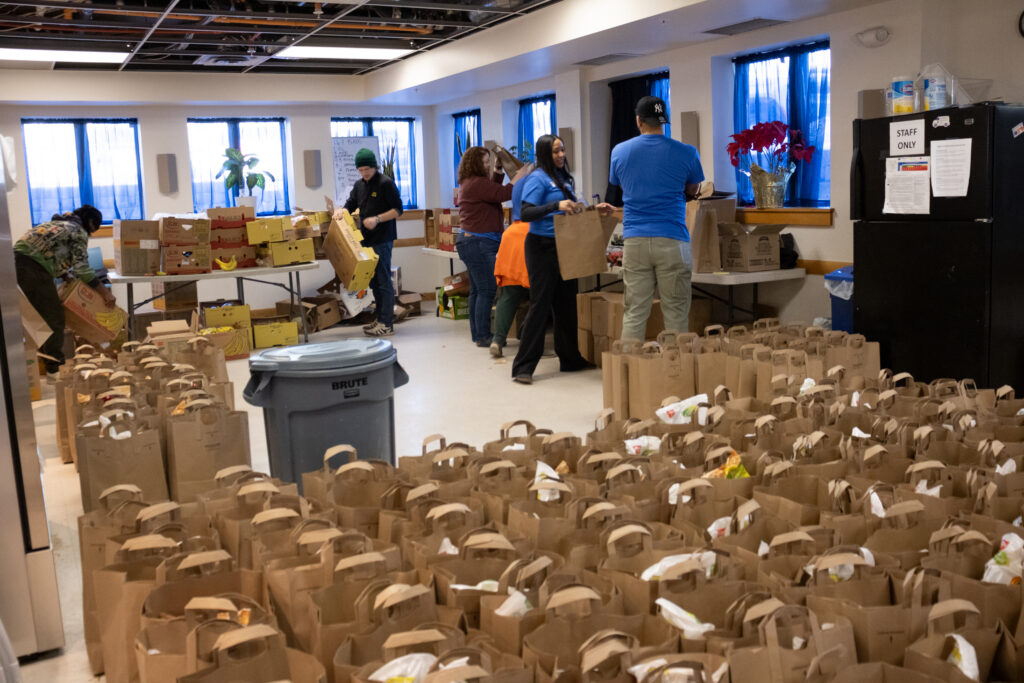
Best Buy volunteers packing grocery bags for GMCC’s weekly deliveries
Thank you to The Progressive Magazine and Joseph Mogul for featuring us!
For more press mentions or press inquiries, visit gmcc.org/press
To support our work, donate at gmcc.org/donate
Recent Comments